> For the complete documentation index, see [llms.txt](https://docs.fastn.ai/llms.txt). Markdown versions of documentation pages are available by appending `.md` to page URLs; this page is available as [Markdown](https://docs.fastn.ai/settings/manage/people.md).
# People
Who can see and change things in this organization.
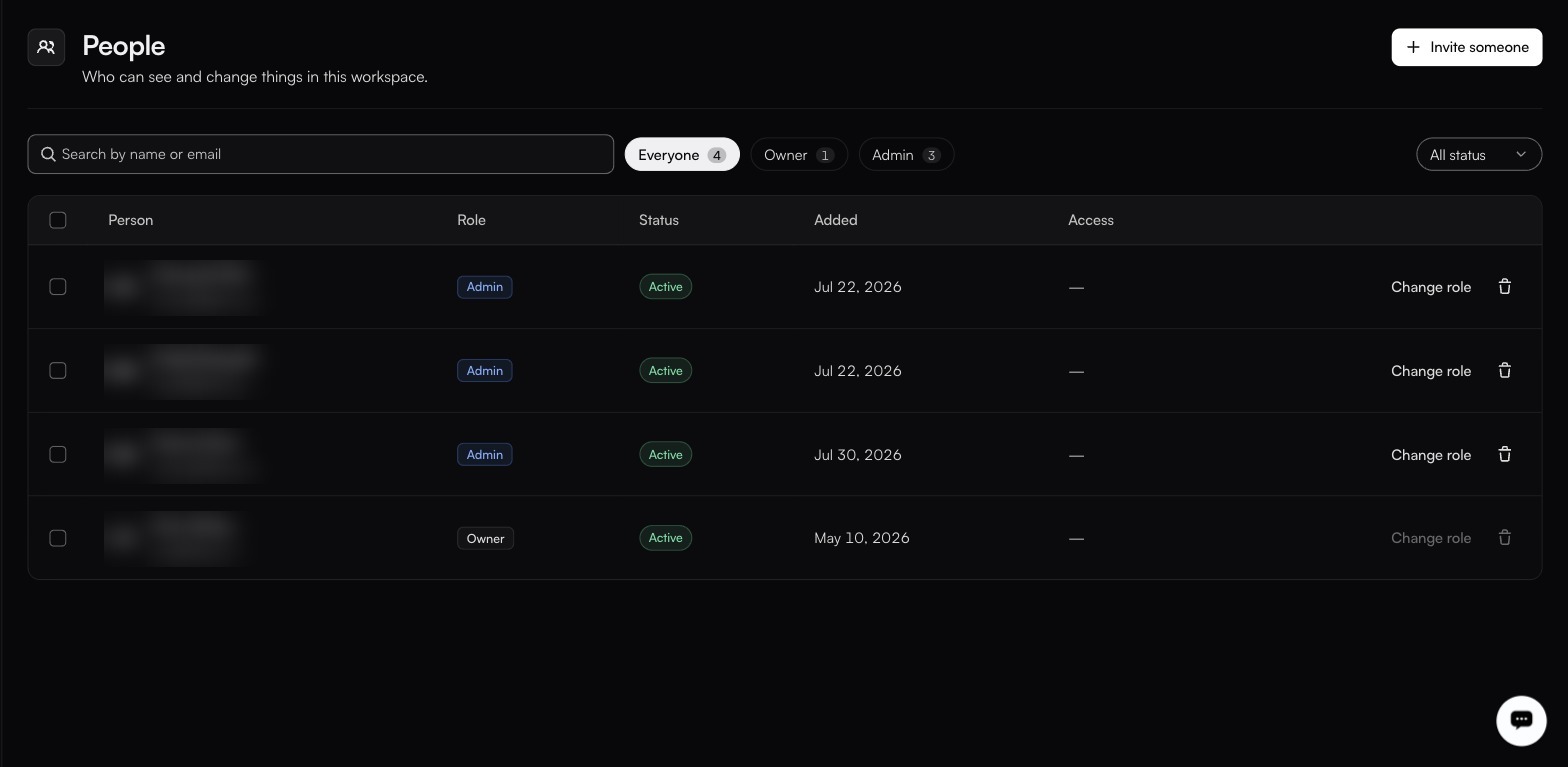
**Settings → People**
Change role is greyed out on every Owner row and on your own.
| Column | Notes |
| ---------- | -------------------------------------------------------------------------------------------------------------------------------------------------------- |
| **Person** | Name and email. |
| **Role** | Their assigned role. **Change role** edits it. |
| **Status** | See [Statuses](#statuses) below. |
| **Added** | When they joined. |
| **Access** | Time-limited access, if any: **Until** a date, **\_N\_d left** in the last week, or **Expired** once it has passed. A dash means access does not expire. |
**Search by name or email** narrows the list. Filter chips carry a count per role (Everyone, Owner, Admin and so on) and the dropdown on the right filters by status.
Each row carries a checkbox. Selecting rows opens a bar with **Change role…** (apply one role to everyone selected), **Deactivate** and **Clear**.
### Inviting someone
**Invite someone** sends an invitation to an email address with a role attached. Until they accept, they appear with status **Invited**, and their row carries **Resend invite** in case the email never arrived.
If you have set up [domain joining](https://docs.fastn.ai/settings/manage/general.md), people on that domain can request access instead of waiting for an invite, and the role you configured there is preselected when you invite them.
### Changing a role
**Change role** on any row. What you may assign is bounded by your own role. You cannot grant more than you hold.
**Change role** is disabled in two places:
* **Every Owner row.** An owner's role changes through **Transfer Ownership**, not here. The current Owner finds it in an Admin's panel; the Admin becomes the owner and you become an admin.
* **Your own row.** Another owner or admin has to change your role.
### Removing someone
The trash icon removes a person from the organization. You cannot remove yourself, and you cannot remove the organization's only owner (transfer ownership first). Their audit-log history stays, so *who did what* remains answerable after they leave.
{% hint style="info" %}
API keys are organization credentials rather than personal ones, so do not assume that removing a person revokes the keys they created. Confirm on [API keys](https://docs.fastn.ai/embed/api-keys.md) and rotate anything they had access to.
{% endhint %}
### Statuses
The status filter offers **All status** plus:
| Status | Meaning |
| ----------------- | ------------------------------------------------------------------------------------------------------------------------------------------- |
| **Active** | Signed up and usable. |
| **Invited** | Invitation sent, not yet accepted. **Resend invite** sends the link again. |
| **Disabled** | Deactivated. The person's panel offers **Reactivate**. |
| **Suspended** | Deactivated. The person's panel offers **Reactivate**. |
| **Can't sign in** | The membership points at a sign-in identity that no longer exists, so the person is locked out until you remove them and invite them again. |
What each role can actually do is on the next page.
{% content-ref url="/pages/77QHtoGMf0SrvnYOP9yw" %}
[Roles](https://docs.fastn.ai/settings/manage/roles.md)
{% endcontent-ref %}
---
# Agent Instructions
This documentation is published with GitBook. GitBook is the documentation platform designed so that both humans and AI agents can read, navigate, and reason over technical content effectively. Learn more at gitbook.com.
## Querying This Documentation
If you need additional information that is not directly available in this page, you can query the documentation by asking a question.
Perform an HTTP GET request on the following URL with the `ask` and `goal` query parameters:
```
GET https://docs.fastn.ai/settings/manage/people.md?ask=&goal=
```
`ask` is the immediate question: it should be specific, self-contained, and written in natural language.
`goal` is what the user is ultimately trying to achieve, the reason they need the answer. Sharing it helps GitBook give you a better, more relevant answer. A goal is most helpful when it describes the outcome the user wants rather than restating the question. For example, with `ask=how do I create an API token`, a goal like `automate deployments from our CI pipeline` lets GitBook tailor the answer to that use case.
The response will contain a direct answer to the question and relevant excerpts and sources from the documentation.
Use this mechanism when the answer is not explicitly present in the current page, you need clarification or additional context, or you want to retrieve related documentation sections.